You Are Here: Home > NEWS > Industry News
Writer: Kaiqian Oil Purifier Release time:2026-08-11 14:21 Clicks:
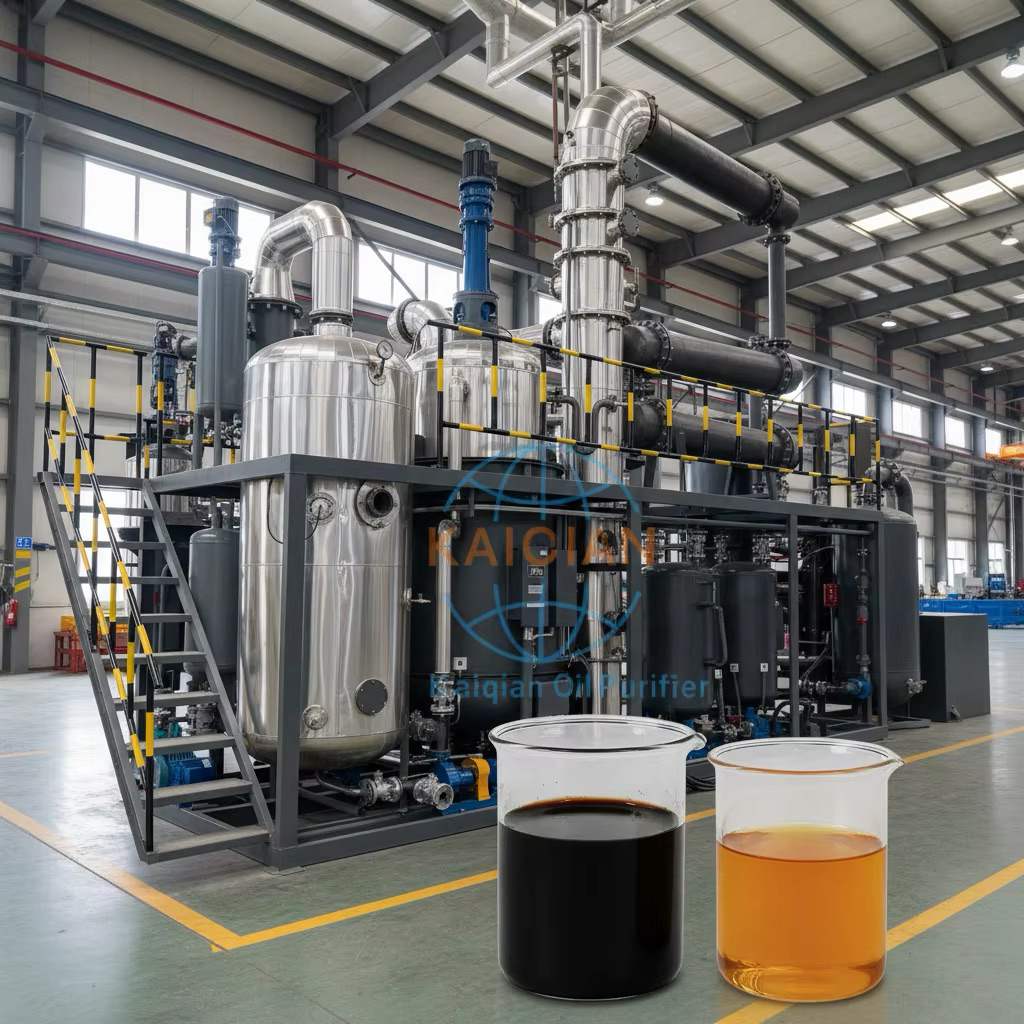
In the industrial recycling sector, distillation is the definitive process for transforming degraded, black waste motor oil back into high-quality base oil or alternative fuels. For professionals evaluating waste oil recovery machinery, understanding the underlying mechanics is crucial. From an engineering perspective, the principle of waste oil distillation relies on two core thermodynamic concepts:
1. The Foundation: Thermal Separation via Boiling Point Differences
Used motor oil is not a single chemical; it is a complex mixture of base oil, water, light hydrocarbons (unburned fuel), degraded chemical additives, and mechanical impurities (carbon soot, metal shavings). The fundamental physical principle of distillation is that different substances have different boiling points. When waste oil is heated progressively inside a distillation reactor, the components vaporize sequentially from the lowest boiling point to the highest:
· Around 100°C: Water content vaporizes and is extracted.
· 150°C - 250°C: Light fractions, such as mixed gasoline or light diesel components, turn into vapor.
· 300°C - 400°C: The most valuable component—the lubricating base oil—begins to vaporize. These hot vapors are then routed through cooling condensers where they revert to a liquid state, effectively separating the clean oil from the heavy, unboilable residues (asphaltic sludge and carbon).
2. The Engineering Key: Vacuum Distillation to Prevent Thermal Cracking
This is the technological barrier that separates standard heaters from industrial-grade distillation plants.
Under normal atmospheric pressure, the boiling point of base oil is extremely high (often above 350°C). If you heat the oil to this temperature at normal pressure, the base oil molecules will undergo Thermal Cracking. The heavy molecular chains will break apart, degrading the valuable base oil into lower-quality diesel or leaving thick, solid coke at the bottom of the reactor.
To preserve the base oil's molecular structure, a high-vacuum environment is mandatory.
According to thermodynamics, lowering the pressure inside a vessel lowers the boiling point of the liquid. Modern distillation plants (especially commercial lines processing 10+ tons per day) are equipped with heavy-duty vacuum pump sets. Under extreme negative pressure, the base oil can vaporize at much lower temperatures (around 250°C - 300°C). This completely bypasses the cracking temperature threshold, maximizing both the yield and the quality of the recovered base oil.
Process Summary
The industrial waste oil distillation workflow can be summarized as: Dehydration & pre-filtration → High-vacuum heating & vaporization → Condensation of fractions → Final polishing (via catalyst or clay). Understanding this interplay between temperature and vacuum pressure explains why top-tier recycling equipment always prioritizes a robust vacuum system.
Address:No.66 Kecheng Road,Jiulongpo District, Chongqing, China
Phone:0086 13983031725
Whatsapp:0086 13983031725
Email:oilpurification@kaiqiancq.com